Moving Mind · Art and psyche
Jung's golden scarab case: when meaning breaks into reality
Francesca Peruzzi, psychologist · 30 January 2026 · 6 min read
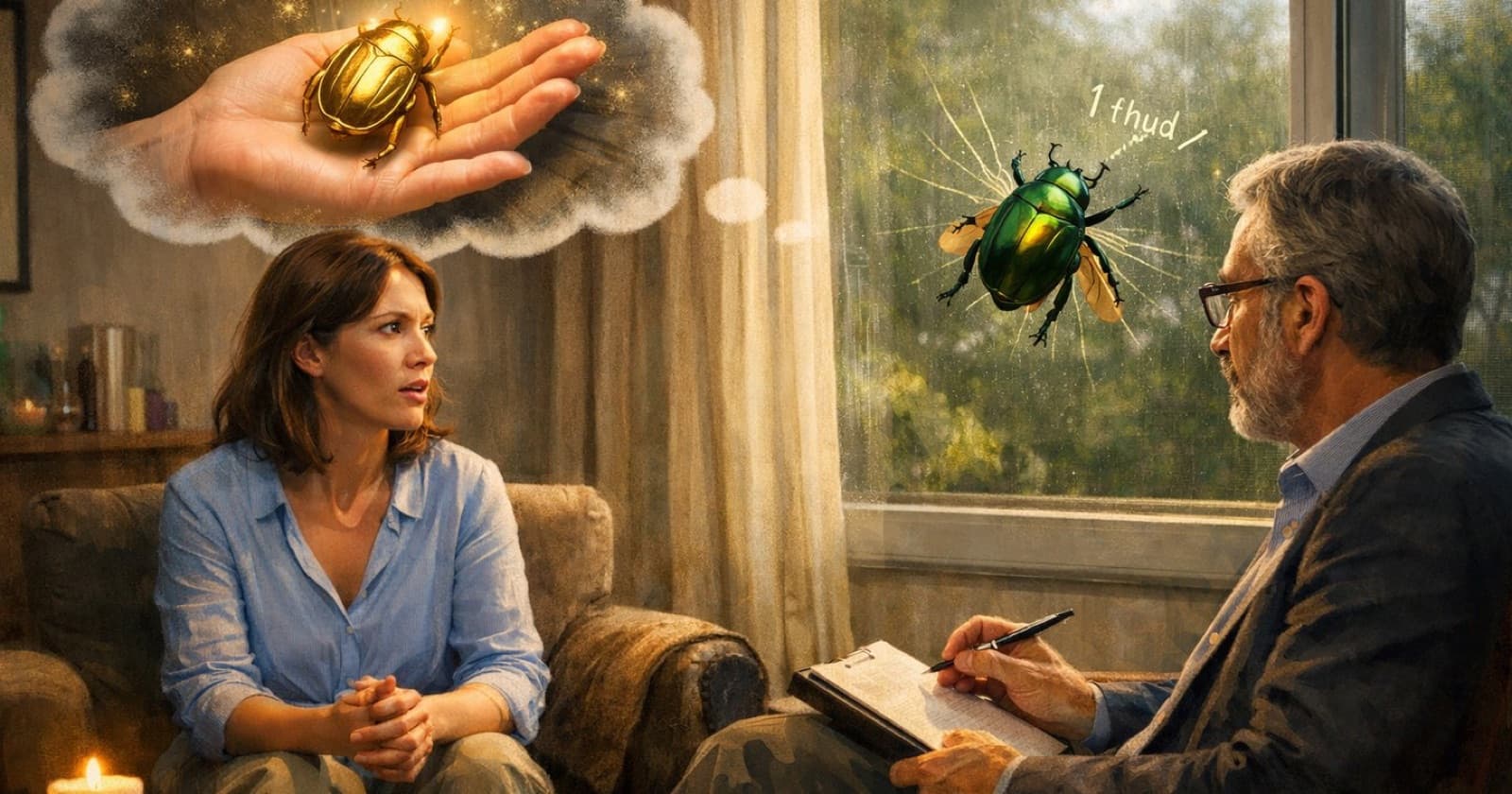
During a session, a patient recounts a dream in which she is given a golden scarab, a symbol of transformation and rebirth, but she does so with a rigidly rational, almost defensive attitude. At that very moment, a rose chafer (Cetonia aurata) strikes the window of the consulting room, interrupting the session. The event has no causal connection with the dream, but it shares its meaning. It is precisely this meaningful coincidence that opens a crack in the patient's defensive closure and allows the therapeutic process to start moving again.
What happens here is not "something strange", but something revealing: external reality and psychic reality line up, showing a coherence that cannot be explained by the tools of mechanism alone.
Beyond causality: the unity of psyche and world
Modern physics has called into question the idea of a reality entirely independent of the observer. The very act of observation changes the phenomenon observed, making completely neutral and objective knowledge impossible. In this sense, the subject is not an external spectator but an active participant in the process through which reality manifests itself.
Carried over into the clinical field, this perspective implies that the therapeutic relationship, the quality of attention, and the expectations and states of consciousness of both patient and carer all take part in shaping the event of illness and the process of healing. Care is never a purely technical operation, but a complex interaction within a relational field.
The scarab case leads us to reconsider the sharp separation between subject and object, between inner world and outer world. If the event cannot be explained causally, it is nonetheless fully comprehensible on the level of meaning. This implies that the psyche is not a domain enclosed in the individual's mind, but takes part in a wider network of relationships, in which the environment too resonates with inner states. Consciousness does not merely observe the world: it helps organise it into meaningful forms. From this perspective, what we call "reality" is not a set of separate objects, but a field of relationships in continuous becoming.
Health and illness as processes, not states
Positivist medicine built its effectiveness on a defensive approach to health: identify the symptom, isolate it, eliminate it. This model has produced extraordinary results on a technical level, but it shows growing difficulty in responding to contemporary forms of distress, which are increasingly marked by chronicity, multiple contributing factors and an interweaving of biological, psychological and social dimensions.
If we shift this lens onto medicine, the traditional distinction between health and illness looks insufficient. Cartesian medicine conceived of the body as a machine made of parts, whose health coincides with the correct functioning of its mechanisms and whose illness is a fault to be removed. Yet if the human being is a dynamic process embedded in a network of relationships, illness too stops being a simple biological error. It becomes a variation in the overall balance of the organism, a signal of lost coherence between its different levels: bodily, psychological, relational and environmental.
Concepts such as health, illness and healing are not universal, unchanging entities: they take on meaning within specific worldviews. When they are defined exclusively within a reductionist and static paradigm, they lose their processual and relational nature. The separation between the sick person and their illness, typical of modern clinical practice, is a direct consequence of this approach.
Illness as a crisis of coherence
Psychosomatic thinking arises from the need to overcome the historical split between mind and body, a split that has deeply marked the development of modern medicine. If illness is interpreted exclusively as a localised, causally determined biological event, every symbolic, experiential and relational dimension of the human being is inevitably excluded from the process of care. A unitary paradigm, by contrast, requires conceptual tools capable of holding together what tradition has separated.
From this perspective, synchronicity is a key principle for rethinking psychosomatics beyond the limits of the linear causal model. It opens up the possibility of understanding the link between psychic and somatic events not as a mechanical chain of causes and effects, but as a meaningful connection that emerges within a unified field of meaning.
Seen this way, illness is not just something that "happens" to the body, but an event that involves the whole person. Symptoms can be read as the organism's attempts to reorganise itself in the face of a disturbance, much as happens in complex systems far from equilibrium. Suffering is therefore not meaningless: it contains information, often not yet symbolised, that asks to be integrated. Ignoring or suppressing the symptom means missing the chance to listen to this information and to support a passage towards a new organisation.
From synchronicity to the bodily symptom
The principle of synchronicity offers an interpretive key for those phenomena in which inner and outer events are meaningfully connected, even in the absence of a direct causal link. Unlike simple synchronism, which indicates mere simultaneity in time, synchronicity concerns coincidence that carries meaning.
Just as, in the golden scarab case, an external event mirrored an internal psychic content, so the body can become the place where an unprocessed conflict or tension shows itself. The psychosomatic symptom is not a mechanical "symbolic translation" of a psychological problem, but the emergence of a dissonance in the network of relationships that makes up the individual. Body and psyche are not two separate entities influencing each other at a distance, but two aspects of a single process.
In psychosomatics, this means considering the body as the place where psyche and matter express themselves simultaneously. The symptom is not only the effect of a biological cause, nor the simple "translation" of a psychic conflict, but a unitary event that involves the whole person and their relationship with the environment.
Read synchronistically, illness becomes the bearer of information that concerns the organism as a whole: tissues, emotions, relationships, personal history and life context. From this perspective, therapeutic work does not consist in forcing a return to the previous state, but in helping the system recognise and integrate the meaning of the event, supporting a broader and more coherent reorganisation.
Psychosomatics: a paradigm shift
Considering the mind-body relationship as a synchronistic phenomenon means letting go of the illusion that the complexity of the human being can be explained through a single explanatory principle. Causality remains a useful tool, but not the only one. Alongside it, we need to recognise the existence of meaningful, acausal connections that link inner and outer events within a structured whole.
Psychosomatics, placed within a unitary paradigm, is therefore not a borderline discipline, but a place of integration.
It invites us to think of health as a dynamic process of participation in meaning, in which body, psyche and world are not separate entities, but different expressions of the same reality in the making.
From this perspective, it cannot be a marginal discipline or an add-on to conventional medicine, but the expression of a paradigm shift.
Caring does not only mean acting on the symptom to eliminate it, but accompanying the patient in recovering greater coherence between the different levels of their experience. This calls for a kind of listening that takes into account personal history, relationships, life context and the way the person makes sense of what happens to them.
Conclusion: from repair to transformation
From the golden scarab case to reflections on health and illness, a vision emerges of the human being as an open system, sensitive to meaning and capable of transformation. Illness, far from being only an enemy to fight, can become an evolutionary threshold, a crisis that opens up the possibility of a new order. Psychosomatics sits exactly in this space: not between mind and body, but in their ongoing dialogue with the world, where meaning often comes before cause, and healing coincides with a shift in coherence even before the disappearance of the symptom.
Francesca Peruzzi, psychologist
Founder of: Moving Mind