Art and psyche
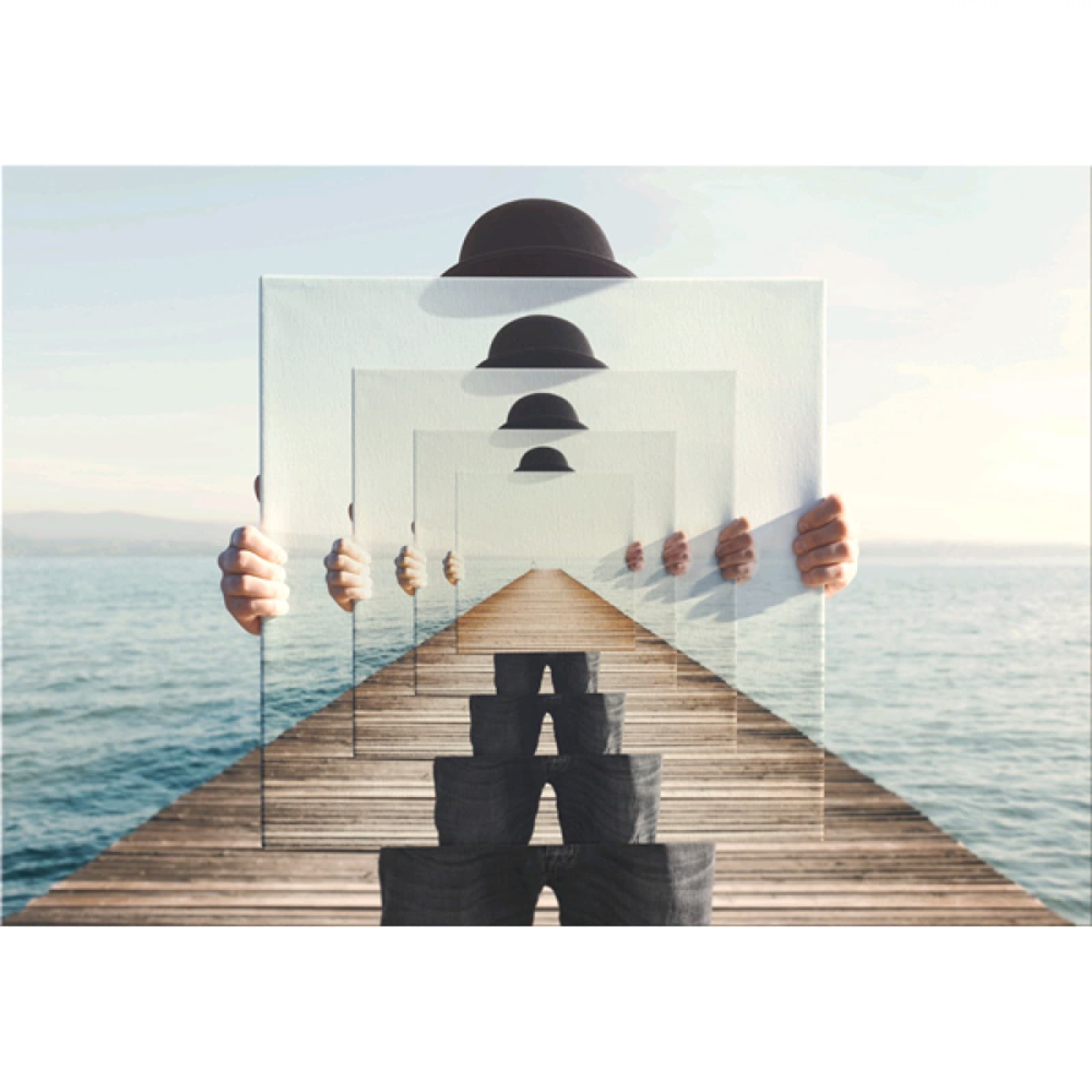
Psychology of art: 2020 in a painting by Magritte.
Francesca Peruzzi, psychologist · 9 February 2021 · 6 min read
Psychology of art for inner transformation
Art has always had the power to communicate the search for what is true and deep, to awaken transformative emotions and sensations, and to put us in touch with our own creative process, and in a sense this is what it shares with psychology.
The psychology of art is a field that fascinates me deeply, both because it is a discipline that allows us to investigate and explain the psychological processes involved in creating and experiencing a work of art, and because it leads us into the world of art as therapy.
In my life I have come into contact with art in many forms and, in my own small way, I have listened to the creative fire within me to build my projects and express myself through my own channel. I have learnt to look at works of art without the boundaries of judgement, simply staying attuned to whatever emerged in me after coming into contact with the work.
Art has always carried me into an undefined space, into the time of becoming and onto a plane of feeling that resonates within me.
Recently this painting by Magritte caught my eye, and I could not help reflecting on how this difficult year, 2020, might be metaphorically represented in it.
Through the images they depict, paintings allow us to come into sensory and material contact with the symbolic world, with the invisible that dwells in the world and in all of us.
Today I have decided to take you on this journey into the painting and, through it, if you wish, into yourself too!
What lies in that stone castle, suspended on a rock and floating above a stormy sea? What symbol or metaphor is hidden behind such a powerful image? What does it awaken in our minds, and what resonates in our unconscious?
Here it is!

The painting that struck me is "The Castle of the Pyrenees", inspired by the flying island of Laputa from "Gulliver's Travels" and used on the cover of Kafka's novel "The Castle".
Before you read on and let yourself be carried along by my flow and personal interpretation, I'd like you to look at it for a while and ask yourself: what does it stir in you, what emerges in you as you look at it?
An analytical view of the painting.
Looking at this image, it is impossible not to enter into relationship with mystery, with that world between the visible and the invisible to which Magritte's surrealism alludes, together with a sense of being that leaves us in the fullness of the question, of questioning.
The image can capture us in a dimension that is paradoxical for the mind, free of the meanings of the real.
That boulder above the ocean, the power of permanence over impermanence, gives me the impression of being invited to experience new fields of knowledge and perception: spaces where the construction of meaning, so dear to our minds as a way of interpreting things, can only remain suspended in a liminal zone. Yet it is a dimension we can somehow grasp, precisely because it is represented on the canvas.
The psychological dimensions hidden in the painting.
Drawing on C.G. Jung's psychological functions and navigating the psychology of art, we can relate the different elements of the painting to four psychological functions:
1- the castle as the thinking function, built on concrete reality;
2- the floating stone, the dimension of what is perceived through the fluctuation of sensation;
3- the sky, the boundless plane of intuition
4- at the base, the sea of emotions with all its movements and our deepest feelings.
When we reflect on the psyche, it is worth remembering that it cannot be reduced to the concept of mind; it is not something inside the human being, but a dynamic system extended into nature and the collective. The psyche is characterised by continuous fluctuations and by a search for a harmony that serves life and transformation.
We could say that the psyche dwells in the world of sense before any meaning the mind may attribute to it.
This image, steeped in symbolism, reflects the experience that emerged most strongly this year out of collective necessity: the act of seeking balance and resilience in the face of an improbable scenario, the storm, the paradox.
It teaches us that we can dwell in impermanence, in the search for balance within human complexity, accepting the plurality of dimensions of reality, of interpretations and of social constructions.
Although many surrealist works are full of an active search for a vision of the unconscious, Magritte perhaps lets us explore more ardently our search for sense and the construction of reality through the act of attributing meanings to things. With his images he enters into a direct relationship with the viewer, playing on our minds' processes of objectification and ordering of meaning, and making us aware that they exist.
Indeed, when looking at this painting it is impossible not to reflect on psychic relativism: reality is not objectively given, and the perspective on things is determined by the qualities of the observer and by the historical and social context they are immersed in.
Art helps us transcend ourselves
Our subjective reality embraces phenomena that are here and now, yet we are used to experiencing life in terms of different degrees of nearness and distance of things, in both space and time. From this perspective we can ask ourselves about the coexistence of a world in which we act with pragmatic interest, and with an interest in shaping our personal reality, and an intersubjective world of shared reality that proclaims itself.
The task of knowledge is to clarify how subjective meanings can become objective facts in everyday life; the task of art is to go beyond a language that postulates such objectifications, the order of meaning, the coordinates.
All too often our knowledge is limited to what we consider important, and our attitudes are determined by our immediate practical interests. Thought wants to objectify and categorise experiences so that it can refer back to them, even when there is a clear risk of distorting reality in order to translate what is little known back into its own dominant reality.
Our limits intersect with those of others; we know everything that our limits know.
When the time comes to face the overwhelming evidence of other people's subjectivity, where it is possible to misunderstand, to dissimulate and to lock things into typifying schemes, we inevitably move away from authentic encounter.

Conclusions
Soul-making means reconnecting with the creative process and exploring it. My work cannot leave out creative processes, because symbolic languages have the power to go beyond words and beyond the visible; endowed with this function, they are full of a sense that we could not perceive consciously by relying on rational tools alone.
A search for meaning in movement and transformation, captured by art and offered back to us with the delicacy or the force of a work.
Observing something or someone that becomes the bearer of a collective message is a process powerful enough to reach the soul. The mere distance between us and a work, between what is lived and what is observed, reassures us that what we see is a representation and cannot cross our boundaries; and yet what we observe is born of the individual and collective dynamics of human nature.
The act of creating gives access to the symbol, and "the psychological mechanism that transforms energy is the symbol." (C.G. Jung)
Psychology welcomes the symbolic messages of art, and the creative process has the power to grasp the dynamic essence of the collective psyche.
I hope I have taken you with me on this journey into the psychology of art.
If you enjoyed this journey, discover my art therapy programmes!
Francesca Peruzzi, psychologist
Contact me
Ask for more information – would you like to share your story? Send me an email.