
Trauma and the body
The window of tolerance: what it is, how to recognise it and how to widen it
Francesca Peruzzi, psychologist · 9 October 2026 · 15 min read

There are days when a badly worded remark slides off you and you manage to reply calmly. And there are days when the very same tone of voice sends your heart into your throat, or switches you off all at once and leaves you with no words. It isn't inconsistency and it isn't weakness of character: it's the way your nervous system, in that moment, is handling the load it's carrying.
Psychology has a name for this difference: the window of tolerance. It's a simple model, widely used in trauma psychology and in body-based approaches, and it gives you a map: where you are right now, what happens when you leave the zone you can stay in, and what can help you come back.
In this article we look at what it is, how to recognise it, why it's narrower for some people, what research does (and doesn't) say about regulation practices and body-oriented psychotherapies, and where you can begin, gently and in small steps.
In short
- The window of tolerance is the zone in which you can feel, think and stay in relationship without being overwhelmed or shut down.
- Above the window is hyperarousal (alarm, agitation, anger); below it is hypoarousal (shutdown, emptiness, detachment).
- The window isn't fixed: stress, sleep, health, sensitivity and life history widen or narrow it.
- Some regulation practices and some body-based approaches have promising evidence, but research is still limited and doesn't replace working with a professional.
- It isn't a diagnosis: it's a map for observing yourself with more curiosity and less judgement.
What the window of tolerance is
The term was proposed by the psychiatrist Daniel Siegel in the late 1990s (The Developing Mind, 1999) to describe the range of arousal within which a person can function flexibly. Pat Ogden and colleagues (Trauma and the Body, 2006) later made it a central tool of sensorimotor psychotherapy, because it allows work with the body while staying within an intensity that can be tolerated.
Inside the window, your nervous system's level of arousal is enough for you to feel alive and present, but not so high that it overwhelms you. Here, in general:
- you can feel emotions without being swamped by them;
- you can think, choose, change your mind;
- you can stay in relationship, listen and be heard;
- your body is present enough and calm enough to give you useful information (hunger, tiredness, the need for a break).
Being in the window doesn't mean feeling good or not having difficult emotions. Sadness, anger or fear can also sit inside the window, if you can feel them without them taking over completely. The point isn't "being calm": it's being able to stay in contact with whatever is there.
An honest clarification. The window of tolerance is a clinical model, a useful metaphor for finding your bearings, not a measurement you can read off an instrument. Its components (arousal, regulation, defensive reactions) have a solid basis in research on stress and the nervous system, but the model itself is a simplification. We use it the way we use a map: it isn't the territory, but it helps us not to get lost.
The model at a glance
Imagine a line that rises and falls through the day. In the middle is the window; above and below are the two ways in which the nervous system, when the load exceeds what it can handle, changes gear to protect you. Neither zone is "wrong": they're defensive responses, which at certain times have been useful.
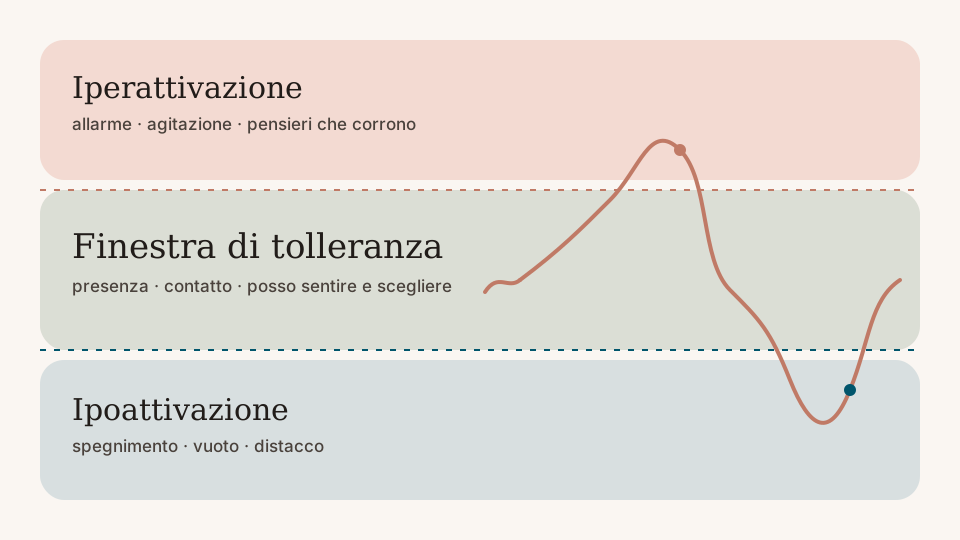
What happens outside the window
When the load exceeds what your nervous system can handle in that moment, it changes gear. This doesn't happen by choice: it's an automatic response, and you feel it throughout your whole organism, not just in your thoughts.
| Hyperarousal (above the window) | Hypoarousal (below the window) | |
|---|---|---|
| Body | Fast heartbeat, short breath, muscle tension, cold or sweaty hands, difficulty keeping still | Heaviness, sudden tiredness, a sense of the body being "switched off" or far away, cold, slowed movements |
| Emotions | Anxiety, panic, irritability, anger, a sense of urgency | Emptiness, numbness, flat sadness, "I don't feel anything" |
| Thoughts | Racing thoughts, catastrophic scenarios, difficulty concentrating | Foggy mind, memory gaps, struggling to find words |
| Behaviour | Reactivity, a need to do or to control, outbursts, difficulty sleeping | Withdrawal, procrastination, isolation, a need to disappear |
| Relationships | Heated arguments, a need for constant reassurance | Silence, detachment, a feeling of not really being there |
Some people recognise themselves mainly in one of the two zones. Others swing between them: days of rushing and alarm followed by crashes. Others still go through moments where the two mix, for example a frozen body and a racing mind. There's no "right" way to leave the window: what matters is learning to recognise where you are and, over time, finding your way back.
Why the window is narrower for some people
The window isn't the same for everyone, and it isn't even the same for the same person on different days. Some factors tend to widen it, others to narrow it:
- Prolonged stress and little recovery. When the load lasts a long time and breaks are missing, the margin wears thin: it takes very little to tip you over.
- Poor or irregular sleep. Sleeping too little makes you more reactive to emotions and makes them harder to regulate.
- Traumatic experiences or unsafe environments. Going through very intense events, or growing up in settings where there wasn't enough safety or attunement, can leave a nervous system quicker to raise the alarm. We talk about this in the article Trauma and the body: why the nervous system stays on alert.
- Individual sensitivity. People with high sensitivity take in more information from their surroundings and from their body, and can reach the limit of their load sooner. It isn't a flaw: it's a trait, as we explain in Highly sensitive person: what it is, what it isn't and how to recognise it in yourself.
- Physical health and life stages. Chronic pain, medical conditions, hormones, pregnancy, bereavement and major changes weigh on your margin for regulation. If you have physical symptoms, the first step is always to rule out medical causes with your doctor.
- Few calming relationships. We're social creatures: the presence of someone who listens to us and makes us feel safe is one of our main resources for regulation. When it's missing, all the work falls on us.
None of this is anyone's fault. A narrow window usually tells a story of adaptation: the nervous system learned to protect you with the tools it had. And what has been learned can, under the right conditions, also be widened over time. With no promises about timescales or results: everyone has their own pace.
What research says about regulation, somatic practices and body-oriented psychotherapies
If the window is a map, it's natural to wonder whether there are routes with evidence behind them. The honest answer is: yes, there are interesting data, but they're still limited and shouldn't be read as guarantees. Here's what emerges from the studies we consulted.
Breathing and physiological regulation
A 2023 meta-analysis of breathing interventions (breathwork) included 12 randomised trials on stress (785 adults) and found a small-to-moderate reduction in self-reported stress (g = −0.35), with similar effects on anxiety (20 studies, g = −0.32) and depression (18 studies, g = −0.40). The authors, however, point out a moderate to high risk of bias in many of the studies, small samples and no follow-up data: they urge caution to avoid what they call a "gap between enthusiasm and evidence" (Fincham et al., Scientific Reports, 2023).
Somatic practices and trauma
The strongest data concern Somatic Experiencing, an approach that works gradually with bodily sensations. In a randomised trial of 63 adults with post-traumatic stress disorder, those who followed the programme showed a reduction in symptoms with large effects compared with the control group, and around 44% no longer met the criteria for the disorder at the end (Brom et al., Journal of Traumatic Stress, 2017; the figures are taken from the review cited below). A randomised trial of 64 people with treatment-resistant post-traumatic stress disorder also found favourable results for trauma-sensitive yoga.
A recent narrative review of somatic practices for trauma (Regulating Trauma Through the Body) describes them as promising complements to established treatments, not as substitutes. The same authors point out the limitations: many studies are small, without a control group, with short follow-ups and subjective measures; the effects on dissociation and emotional regulation are inconsistent; specialist training matters and, if the pace isn't well calibrated, there's a risk of overloading the person.
Body-oriented psychotherapies
A 2021 systematic review with meta-analysis gathered 18 randomised trials of body-oriented psychotherapies (1,297 patients, various conditions). Compared with controls, it found medium-sized effects on psychopathological symptoms (g = 0.56) and psychological distress (g = 0.52), still present, in reduced form, at an average follow-up of about seven months. The result is encouraging, but the authors warn that the studies differ greatly from one another, that the effect shrinks when the control group is active and that publication bias can't be ruled out (Frontiers in Psychiatry, 2021). No clear differences emerge, on the other hand, for quality of life or bodily experience.
Why a pathway that isn't only verbal can make sense
Words are a precious tool, but they don't reach everything. Many alarm or shutdown reactions are learned and live in the body and in implicit memory: they arrive before thought, and rational understanding often isn't enough to change them. This is why trauma psychology (Ogden, van der Kolk, Levine) has developed approaches that also work through the body, movement, imagination and creative expression. Their clinical purpose is to offer another way in, at a bearable intensity, and to stay inside the window while the work is happening.
The data above show that these approaches can be a useful support for some people, especially as part of a broader pathway. That doesn't mean they're the answer for everyone, or that words aren't needed: often the two routes work best together.
How to recognise your window
Getting to know your window doesn't require any tools: it requires gentle observation. The idea is to notice the early signals, the ones that appear before you're completely outside, when it's still easier to do something.
For a few days, you could try asking yourself these questions three or four times a day (even just in your head):
- Where do I feel it in my body? Breath, jaw, shoulders, stomach, hands: what do I notice?
- What's my energy like? Higher than usual, average, lower? No need to judge it, just name it.
- Can I choose? Can I respond, wait, say no, or am I reacting on autopilot?
- What happened just before? A message, a meeting, too little sleep, an argument, a crowded place?
Over time you'll start to see patterns: the situations that bring you close to the limit, the signals that come first, what helps you come back. Some people discover that their early signal is tension in the throat, others a sudden irritability, others an urge to scroll on their phone or to disappear.
A useful rule: don't try to correct, just notice. Observing yourself with curiosity, without judging yourself, is already a way of regulating.
If you'd like a more structured starting point, our free tests (six questions, about two minutes) help you understand where your nervous system is struggling most. They're not a diagnosis, but a first snapshot with a few practices to try straight away: you can choose the one closest to how you feel, from Stress and burnout, Anxiety and panic, Trauma and the body and High sensitivity.
How the window can be widened: where to begin
Widening the window doesn't mean "always staying calm". It means, over time, having more margin: feeling more without being overwhelmed, and finding your way back more quickly. Here are a few directions to try gradually and with curiosity.
Through the body
- Slow breathing, with a slightly longer out-breath. A few minutes, without forcing. If breathing makes you agitated, return to your natural breath and try something else.
- Support and grounding. Feeling your feet on the ground, your back supported by the chair, the weight of your body. Looking around and naming three things you can see helps you come back to the here and now.
- Gentle movement. Walking, stretching, rocking, shaking out your hands: some people regulate better by moving than by staying still.
- Temperature and touch. A warm mug in your hands, a blanket, cool water on your face: small signals of safety for the body.
Through the mind
- Naming what you feel ("I'm agitated", "I'm shut down") helps you take a little distance without denying it.
- Easing self-criticism. A narrow window isn't a failure: it's an adaptation. The tone you use with yourself matters.
- Guided imagery of a safe place, if that's a resource for you: a real or imagined place that brings you relief. If, on the other hand, images make you agitated, you can leave this aside.
Through creative expression
Drawing, colouring, writing, modelling, moving with your eyes closed: when words aren't enough or don't come, a creative gesture can give shape to what you feel and give you back a little distance. You don't need to know how to draw: it's the process that counts, not the result.
Through relationships
- Co-regulating. Being close to someone you trust, through touch, a calm voice, a presence, helps the nervous system to relax.
- Asking for breaks and time. Saying "I need a moment" is a way of staying in the window.
Through routine
- Regular sleep, meals and breaks are the foundation: without them, every other practice is harder going.
- Reducing the load where you can. Sometimes widening the window also means taking weight off, not just learning to carry it.
A few cautions
- Go in small steps, for a few minutes at a time. If a practice makes you agitated or feel worse, stop: it isn't a failure, it's information.
- If you have a history of trauma, body-based practices can bring up memories or intense sensations: in these cases it's better to explore them with the support of a professional, who can help you pace the intensity.
- These suggestions are general guidance and don't replace a clinical assessment or individual support.
When support can help
You can do a lot on your own, but there are times when having a guide makes the journey safer and less tiring. In my work I use approaches that aren't only verbal, working through the body, imagination and creativity, because for many people they're a more natural way in than words alone:
- Radici e Ali (Roots and Wings): an individual psychological pathway, online or in person, with a body-based approach.
- Balance (a Moving Mind class): a group practice combining mindful movement, breathing and somatic strategies, at your own pace, with no choreography. Discover the Moving Mind method.
- Group somatic art therapy: a workshop combining somatic practices and creative experimentation, with no artistic skills needed. Discover the experiences.
If you'd like to start with something free, the welcome kit for listening to your body (a guided breathing and grounding practice, a gratitude writing exercise, a grounding exercise and one reflection a month) is designed precisely as a first step: Get the kit.
Frequently asked questions
Is the window of tolerance a scientific model?
It's a clinical model, born in trauma psychology and also used in many body-based approaches. Its components (arousal, defensive responses, regulation) draw on research into stress and the nervous system, but the model itself is a simplification and we haven't found direct experimental testing of it. It's used as a map, not as a measurement.
How do I know whether I'm above or below the window?
By observing your body, emotions and behaviour: agitation, a fast heartbeat and racing thoughts usually indicate hyperarousal; sudden tiredness, emptiness and detachment usually indicate hypoarousal. It isn't a diagnosis: everyone has their own signals, and getting to know them takes a little practice.
Can the window of tolerance be widened?
From a clinical perspective, yes, over time and with gradual regulation practices, supportive relationships and, when needed, work with a professional. We can't promise timescales or results, because they depend on each person's history and stage of life.
Are breathing and grounding practices enough?
For many people they're a good starting point and can help in moments of tension. When difficulties are intense, long-standing or linked to traumatic experiences, it's advisable to combine them with support from a professional. If you have physical symptoms, rule out medical causes with your doctor first.
Do body-based and creative therapies work?
Research shows encouraging results for some somatic practices and body-oriented psychotherapies, but the studies are still few, varied and often small. That's why we talk about possible supports, which for some people are more accessible than words alone, and not about guaranteed solutions. Often the different routes work best when combined.
Is a narrow window a sign of trauma or of a diagnosable condition?
Not necessarily. A narrow window can depend on prolonged stress, high sensitivity, poor sleep, health or life history, and it can also be linked to traumatic experiences. Only an assessment with a professional can say more about your situation.
When to ask for help
You might consider talking to a professional if:
- you notice you're often outside the window, in either direction, and it's weighing on your work, relationships or sleep;
- regulation practices aren't enough, or they make you agitated;
- you've been through very painful or frightening events and your body still seems to be on alert;
- you often feel disconnected from yourself or from the world.
Where you can start
You don't need to know already what you need. You can choose the step that feels closest to you:
- Take a free test (six questions, about two minutes): choose the one closest to how you feel. Stress and burnout · Anxiety and panic · Trauma and the body · High sensitivity. All the tests are on this page.
- Get the welcome kit for listening to your body: a guided breathing and grounding practice, a gratitude writing exercise, a grounding exercise and one reflection a month.
- Book the discovery call, free and 15 minutes long, to work out together whether and how to work together: Book the discovery call.
- Try a group experience with Balance or somatic art therapy, to move, breathe and create at your own pace.
The content of this article is for information only and does not replace an assessment, diagnosis or treatment by a professional. If you have physical symptoms, see your doctor first.
About the author
Francesca Peruzzi, clinical psychologist with a Jungian and psychosomatic orientation, and art therapist. She works with trauma, anxiety, stress and sensitivity through pathways that integrate body, imagination and creativity. She is registered with the Order of Psychologists of Lombardy, Italy, no. 21385.
Last updated: 9 October 2026.